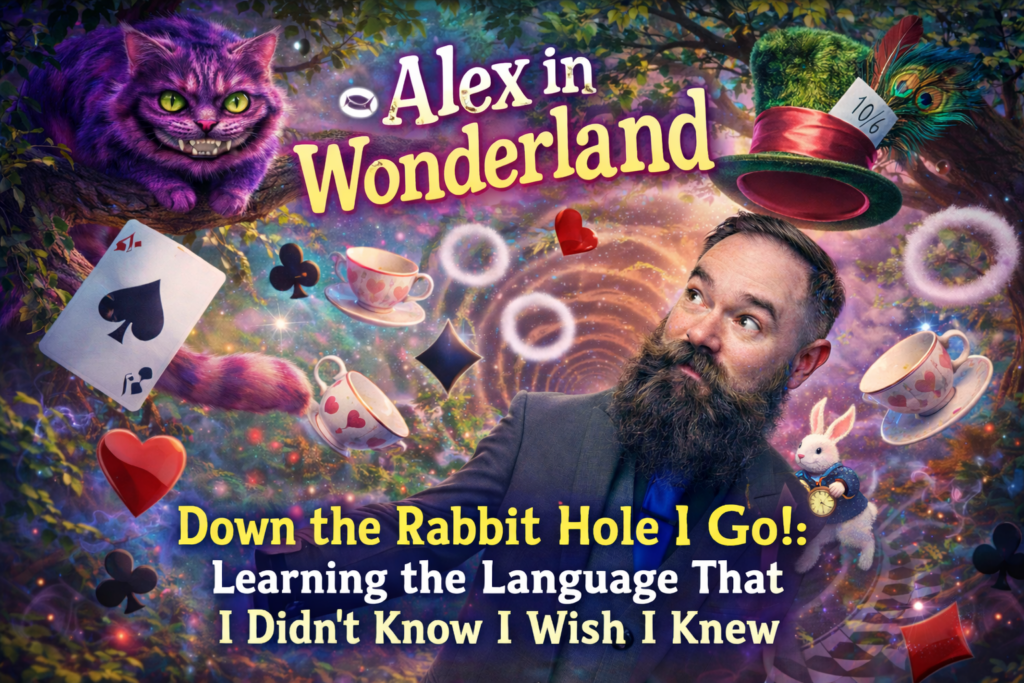
Down the Rabbit Hole I Go!: Learning the Language I Didn’t Know I Wish I Knew
By Alex Sheehan, with contributions by Alex Rodriguez
Have you ever done something that just felt natural to you? Something you gravitated toward without really knowing why. No training. No roadmap. No compass. No one explaining what it was or what it meant. Just something that felt instinctive, like breathing.
Maybe it was writing. Maybe it was drawing. Maybe it was singing, dancing, storytelling, or performing. And maybe you didn’t even have a name for it at the time. For me, that thing was spoken word poetry. Long before I ever heard phrases like arts in mental health, creative expression or social prescribing, I was just trying to survive. I didn’t know I was participating in something that researchers, clinicians, and public health practitioners were describing as therapeutic, community-building, or recovery-oriented. Frankly, I didn’t give a damn. I was just trying to find a way to say what felt impossible to say, to make the dark thoughts stop and the anguish dissipate. And spoken word became that language.
At the time, I didn’t know that what I was doing was part of something much bigger. But looking back now, it feels a bit like falling down the rabbit hole to Wonderland. You start somewhere ordinary. You follow a curiosity. And suddenly you’re in a world that feels strange, confusing, and oddly revealing all at once. That’s what poetry became for me.
There was a time when speaking about what I was experiencing felt impossible. Deep, inescapable depression, severe anxiety, mania, suicidality. Mental illness twisted, contorted, and distorted language. It created a distance between what I was feeling internally and what I was trying to explain externally. I learned very quickly that sometimes the words that exist in everyday conversation simply weren’t big enough or honest enough to capture my experience. Spoken word poetry gave me permission to speak differently. It allowed me to bend language to my will, to break structure and to tell the truth sideways because it was all my own.
In a poem, you don’t have to explain everything neatly. You can, but you don’t have to. You can speak in metaphors, age-old allegories, fragments, emotion, or rhythm. You can say things that might otherwise feel unsayable. For me, performing poetry became the first time I felt like people could truly hear what I was trying to communicate.
Not “listen” like doctors told me they were doing. But hear.
And that distinction mattered more than I can explain.
Something else happened that I didn’t anticipate. I wasn’t the only one doing this. As I started attending open mics at my local café or brewery on Tuesdays and Thursday nights, poetry readings, and spoken word poetry slams, I began meeting other writers, musicians, and performers who were doing something very similar. Some were processing grief. Some were navigating trauma. Some were working through mental illness, identity, addiction, or loss. The point is, they were processing their own healing journeys in a way that was comfortable and made sense to them. Even if it made zero sense to me in the moment, I could instantaneously realize they were speaking their truth to the universe. And in those brief moments, that universe was a room of fifty strangers.
Many of us had arrived there for the same reason: because creative expression felt like the only place we could be honest. None of us called it “arts in mental health.” None of us used terms like “therapeutic.” It just “was.” We were just showing up with our stories, getting on a stage, and belching out our truths to an audience full of people. And in doing so, we were quietly building something that looked a lot like community.
Looking back, I realize that those rooms crowded with folding chairs, soft lighting, and microphones were some of the most honest and trusting spaces I have ever been in. Even though more than half the time I never saw these people ever again. Funny, right? People weren’t pretending to be okay. They were telling the truth out loud. Telling it forwards, backwards, diagonally or sideways. It was theirs.
I Finally Learned The Words I didn’t Know I was Looking For!
In Fall 2023, I met a stranger who has since become one of my dearest friends. Upon our initial meeting, I found out that she was a doctoral researcher who has dedicated her scholarship and passion to the very things I did not know the words for. Arts in mental health and social prescribing. Go figure. The world is funny like that.
Instead of traditional western ideas of medicine prescribing only clinical interventions, she taught me some healthcare systems are beginning to “prescribe” participation in community-based creative and social activities that promote wellbeing. Medicaid expansions in California, Arizona, New Mexico, and Oregon have begun covering health practices such as dance, music therapy and sweat lodges to help support physical and mental health, as well as connecting to cultural and spiritual upbringing. When I first learned about this concept, I had a strange reaction. Part of me thought: “Wait… this is a real THING?” Because the truth is, I had already been doing it for years. No doctor told me to. No program referred me. No one handed me a brochure and told me, “Here. Read this”, without so much as looking me in the eye. I just found my way there. Or maybe more accurately, poetry found its way to me. And all it took was a quick conversation with a new friend to teach me this language.
One Mind has even been embracing this wonderful field through Apollo & Psyche, an evening of art, music, storytelling, and dance, all in support of mental health! Inspired by Apollo, the God of dance, music, and healing, and Psyche, the Goddess of the soul and mind, One Mind is celebrating the timeless connection between the arts and healing and building community.
Why Arts in Mental Health and Social Prescribing is so Important
While the intersection of arts and mental health has been both acknowledged and practiced across Indigenous and culturally rooted communities for centuries, the research evidence in this space has only more recently been burgeoning. Evidence from the World Health Organization has positioned arts engagement as a health behavior that can support the prevention, promotion, and rehabilitation of mental health. Epidemiological evidence suggests that arts and leisure engagement can reduce depressive symptoms while bolstering levels of self-reported health, happiness, and life satisfaction. One US-based cohort study even found that older adults who engaged in creative hobbies at least monthly were 20% less likely to be depressed than those who never engaged in hobbies.
This research connection has opened pathways internationally for social prescribing, a practice in which patients can be referred to local, non-clinical, community-based activities (such as art classes, gardening, or volunteering) to improve their mental health. While the formalization of this concept originated in the UK, it has expanded globally across more than 30 countries, including Australia, Canada, Japan, and Singapore. This practice has also gained momentum in the US, as both private and public institutions begin to scale existing models, including blended funding, insurer involvement, and longitudinal community partnerships. The opportunity lies in augmenting traditional forms of mental health care to directly support mental health through arts engagement, as well as secondarily by building social support, an important social driver of health.
What This “New” Language Means To Me
One of the things I’ve come to believe is that art and creative expression often acts as forms of translation. There are experiences that don’t easily fit into everyday language, and that’s perfectly okay. Sometimes, much like Wonderland, it just takes a new perspective or new way of looking at things because we can all choose to see things forwards, backwards or even sideways! Through this new language I have learned that art gives those experiences another route outward—because remember, sometimes the way out isn’t always up, but through!
A poem can hold despair.
A song can carry anger.
A painting can reveal confusion.
A story can express hope.
A dance can invoke healing.
Creative expression allows people to communicate experiences that might otherwise remain invisible. And sometimes, that expression becomes a bridge not only to understanding ourselves, but to helping others understand us too. And for me, it went even further. It helped save my life.
Finding Your Own Wonderland
The truth is that creative healing doesn’t look the same for everyone. For some people it might be poetry. For others it might be painting, photography, music, theater, journaling, or dance. Sometimes it’s gardening. Sometimes it’s storytelling. Sometimes it’s simply being part of a space where creativity is welcome.
The point isn’t the medium. The point is the expression. In finding a place where your internal world has room to exist outside of yourself. In that sense, maybe the rabbit hole metaphor I know and love really isn’t so far off. Because sometimes what feels like tumbling into the darkness is actually the beginning of discovering a world where your story finally makes sense. And for those who have fallen through their own rabbit holes, these expressions become bridges by creating ways of recognizing pieces of ourselves in the stories of others that further connect us.
I would like to end this piece by sharing a poem with you all. Here is Alex in Wonderland: