
This Mental Health Awareness Month, We Need to Think Bigger
By Pooja Mehta
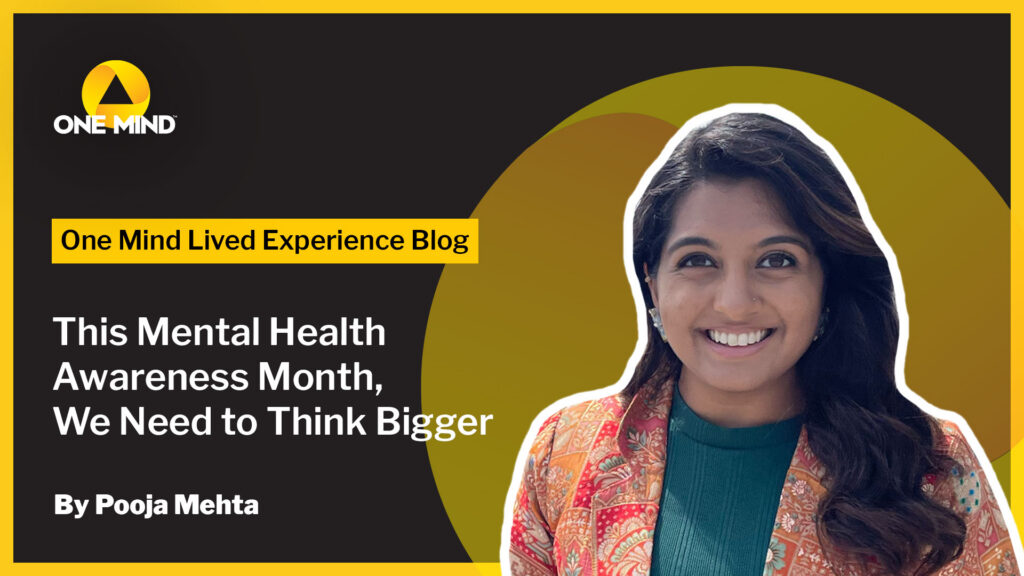
Mental health awareness month is approaching, and around the country, organizations are preparing for their mental health advocacy campaigns and recognizing the mental health champions leading that advocacy. These campaigns, these champions, they’ve done transformational work in building out our mental health care system. And yet as I look across the political and policy landscape, I find myself thinking back to summer 2021–the only time in my life I wanted to die–and wondering if we’re missing the mark.
Let’s back up a bit.
I was diagnosed with anxiety with auditory hallucinations in 2010, and have attempted suicide three times since then. But when each of those attempts “failed,” I found myself overwhelmed with gratitude because I didn’t want to die. Each of those attempts was a byproduct of my symptoms running unchecked, and the hallucinations taking over to the point that the only way I could think to end the voices was to end myself. There was no ideation there, there was no desire for my life to be over. I didn’t experience that feeling until over a decade later. After I had fought hard to get to a place of recovery, after I hadn’t heard the hallucinations for nearly 5 years, I found myself wanting to end my own life not because of my mental illness, but because of my circumstances.
I define mental health as “having emotions that meet the context, and having the tools and strategies to manage those emotions.” And in summer of 2021, the context of my life was, in a word, bad. I was unemployed and job searching with no experience, since every internship or professional development pathway I had during my masters got shut down because of the COVID-19 pandemic. I had left an abusive relationship and was picking up the pieces while seeing my peers celebrate their engagements on Instagram. My brother had died a year earlier, and I learned in real time that people in their 20’s don’t want to deal with grief, leaving very few people in my corner.
Through all this, I never stopped engaging in mental health care. I had therapy and medication (which I was paying for out of pocket since I fell in the Medicaid gap), I had coping skills and self-care practices, but it didn’t matter. Every part of my life felt like a challenge, I had nothing to convince me that tomorrow would be better than today, and how insane that I could expect an hour of therapy, three little pills, and mental health walks to be able to manage that.
But as a movement, that’s what we do every day.
Half the Equation
Mental health has become one of the most widely agreed priorities among Americans, with a powerful collective of champions from all walks of life. Since that summer of 2021, we have seen once-in-a-generation sustained investment in mental health. But the rates of mental health concerns among adults haven’t improved. The suicide rates have flatlined. And projections show that within 10 years, demand for mental health services will outpace supply by a factor of 4 to 1. Why isn’t the power translating to progress?
More therapists, better insurance coverage, building out crisis services, the individual-level solutions are things that we can all agree on and where much of the advocacy focus lies. There’s still so much that needs to be done in that realm, and I do not for a second want to suggest that we stop fighting for those changes. But we also need to recognize that it will never be enough, unless we also address the people and policies driving the skyrocketing need for these systems in the first place. It will never be enough, unless we start advocating for a public health approach.
Housing instability, economic precarity, income inequality, exposure to violence, social disconnection — these are not just things that happen to people who are already struggling, they cause the struggle. A comprehensive 2024 review in World Psychiatry found links between these social conditions and poor mental health across the lifespan, noting that people exposed to more unfavorable social circumstances are more vulnerable to poor mental health in ways “often determined by structural factors.” When families received the expanded Child Tax Credit in 2021 child behavioral problems dropped by 10% within months. When payments stopped, those gains reversed. When communities are subjected to violence, PTSD, depression, and anxiety spread not just to direct victims but to entire neighborhoods. When housing costs consume more than half of a family’s income, the chronic stress it produces is biologically indistinguishable from trauma. And the WHO’s Commission on Social Connection found in 2025 that loneliness, driven by inadequate community infrastructure and public policy, accounts for an estimated 871,000 deaths per year globally.
This isn’t a secret. Every major mental health organization has policy positions that support improving the social drivers of mental health, and the very first goal of the CEO Alliance for Mental Health’s Unified Vision calls for promoting the vital conditions necessary to optimize mental health for all. But our advocacy efforts stop short of that goal, stop short of policies and political choices that determine whether people have stable housing, enough food, economic security, and freedom from fear.
Things We Can All Agree On
We worry that making that jump would turn mental health into a partisan issue. But what if, instead, we could take the overwhelming agreement on the urgent need to prioritize mental health and lend it to creating a world that allows people to be mentally well? Advocating for a world that supports mental health, one where people have housing, food, safety, and community shouldn’t be partisan. And according to everyday Americans, it isn’t–voters are backing leaders who are increasing access to affordable housing, opposing cuts to Medicaid and SNAP, and fighting against everyday people being kidnapped in their communities. The bipartisan consensus doesn’t just exist on mental health in theory, it exists on the specific policies that would actually address the context that is taking such a toll on our mental health. As a movement, we need to have the courage to make sure that the policies and practices that we’re championing do the same.
Summer of 2021 was the only time in my life I wanted to die. I’m still here because I had an hour of therapy, three little pills, and mental health walks–and those only started to help once I was financially secure, emotionally and physically safe, and connected to community. I’m still here because my tools got stronger AND my context got easier to manage. We need to be tackling this problem from both sides at scale. So as awareness month unfolds, can we think bigger? I want to ask more of us, especially those who already call themselves mental health advocates. I want us to use our position, our power, to lead advocacy campaigns and recognize champions that are addressing everything required for mental health for all. Going to therapy matters. Checking on your friends matters.
And investing in a world that supports mental health for all? It matters. A lot. And it’s something we can all agree on.