
The Insanity Principle: How My Lived Experience of Schizophrenia Shaped a Creative Practice
by Linda Carmella Sibio
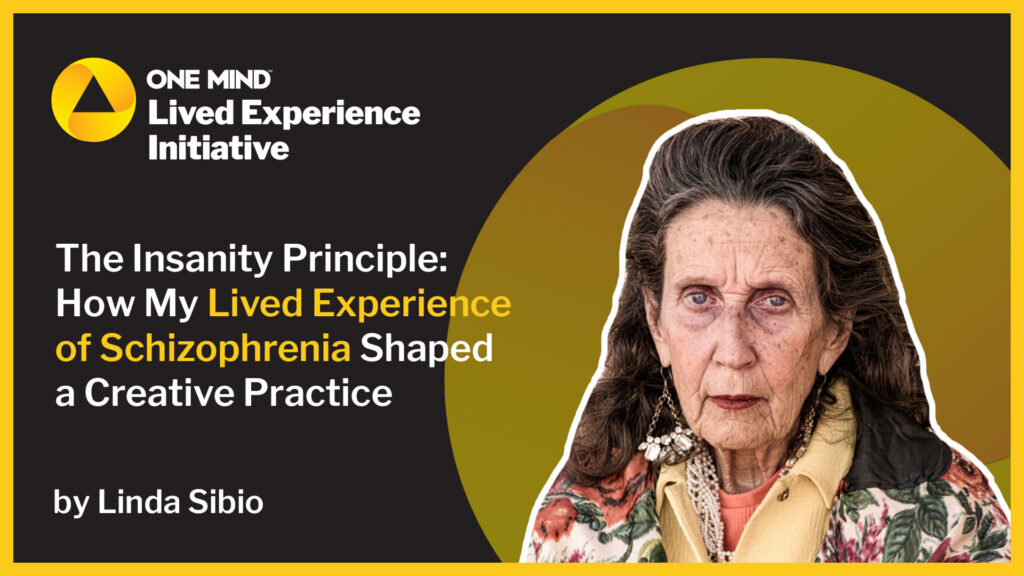
I have learned that unpleasant emotions and thoughts that seem “not normal” do not always have to be ignored or minimized. They can be observed, understood, and used in creative work. A healing method I call “The Insanity Principle” grew from my lived experience of schizophrenia and from my belief that lived experience can be a source of knowledge, creativity, and connection. Based on my experience, I believe so strongly in the potential of this method that I have planned a study in collaboration with UC Davis to ground it in science.
I am an artist with schizophrenia. Symbols such as hieroglyphs help me find my way. I began developing these exercises through my performance process, using long build-ups of abstract body movement and voice. The exercises helped me work with my own experiences, including what I describe as dismemberment and multiple subjects, as well as delusions, hallucinations, depression, trauma, and dissociation. Over the past 50 years, these methods became a set of workshop exercises that I call The Insanity Principle. I chose the title through my philosophy background, after reading Anti-Oedipus by Gilles Deleuze and Félix Guattari. To me, it represented a fundamental change in my thinking.
I have written a 228-page artist’s book outlining more than 223 exercises.
Below is an illustration of the thoughts and emotions depicting patterns in my own schizophrenic thinking. The chart can be used in performance, writing, or visual art lessons.
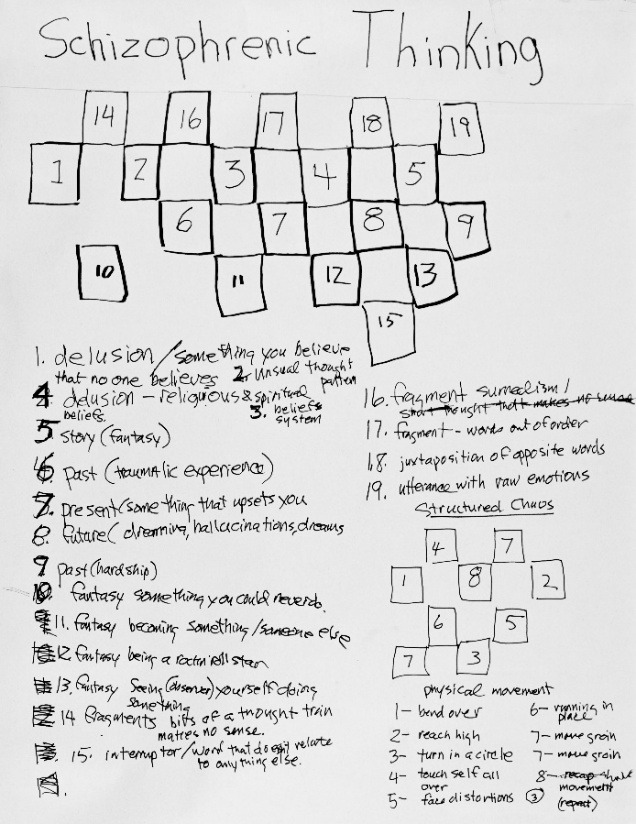
This model presents my thoughts about how we emotionally work with fragments and opposites. For example, if the emotion is happiness, you may then work with sadness, its opposite. This juxtaposition can help you explore and work with each emotion. It may also help bring the different emotions we are feeling into greater balance.
The Insanity Principle is built from exercises that use experiences associated with mental health challenges as structures in creative work. Participants explore their thoughts and emotions, seeing how they interact and combine. Participants have reported feeling emotionally lighter after the exercises and gaining a deeper understanding of how they think and feel. This understanding can offer tools for working with emotional states in daily life.
The exercises include emotional workouts, externalizing emotions, working with opposites, and movement practices that can be used in daily life. The methods described below are a sampling of the exercises in my book.
Emotional Workout
This requires:
- The use of the voice in five places in the body: High tone placed in head, sound placed in nose (reminiscent of Buddhist monks), throat sound, chest sound, and deep stomach sound.
- Once each sound is established you add emotions (head-happy); nose (spiritual); throat (anger), stomach (sadness), chest (neutral);
- Once the above is established you add body movement with head and tongue movements; stiff movements (spiritual); throat movement (full body lunging forward and pushing hands out); stomach (curl up in fetal position and rock back and forth);
When these elements are combined, participants may enter what I describe as a non-linear schizophrenic state and report feeling more emotionally balanced and strong.
Externalizing Emotions
This section includes exercises that release deep feelings, whether angry, happy, sad, or frightened.
Externalizing is a way of expressing internal thoughts and feelings through the body. Participants have reported that this can help them release or regulate feelings of panic, trauma, and anger. For example, a participant may visualize something they are angry about and release the anger by saying, “Get out!” in an angry voice. For me, externalizing means opening or sharing the symptom.
In my experience, externalizing internal thoughts, emotions, or delusions is most productive in a group workshop setting, because this work needs a witness. This process is an integral part of The Insanity Principle.
Example: Spaceship Delusion Story
My student Joseph had a spaceship. His spaceship was all he talked about. In a performance class, I gave him an exercise in which he tried to convince the other students that he had this real spaceship. Toward the end of the exercise, he said, “Well, maybe I don’t have a spaceship.” He began to question the certainty of the delusion himself.
Communication and Connection
These exercises can support communication between people with mental health challenges and the broader public. People with and without mental health conditions can participate together. Working in a group puts everyone on the same level, helping them communicate and appreciate each other.
Example:
In 1993, I conducted a social experiment at the Los Angeles Theatre Center. I had artists studying with me from Turkey, Mexico, Sweden, and other countries, along with artists from our Skid Row group, Operation Hammer, many of whom lived with mental health challenges. Introductions included only a name and one line about themselves. We worked on a group show for about six months. The artists from Skid Row sold tickets throughout Skid Row and downtown Los Angeles. They would say, “My name is … and I am an interdisciplinary artist. I am selling tickets to our show at the Los Angeles Theatre Center, called ‘The Red Ant Cometh.’” The contemporary artists became more willing to be spontaneous, explore their inner lives, and do brilliant work. The groups learned from one another.
Using Opposites
We can use these exercises to explore and better understand our individual emotional experiences.
The four core emotions I work with are happy, sad, frightened, and angry. What is the opposite of “sad”—is it “happy”? What is it for you, personally? Not every person has the same emotional opposite.
More Details: Fragments and Opposites
When working with emotions, I provide a chart that connects emotions and fragments. This method helps each person explore how fragments and emotions appear in their own experience. I have used it with people living with schizophrenia, bipolar disorder, schizoaffective disorder, clinical depression, trauma, anxiety, and other mental health conditions.
Using Emotional Tools in Everyday Life
Example: Spine Exercise
The emotions tied to this movement exercise differ from person to person. For example, someone feeling anxiety or panic while sitting at work may use a spine movement to explore an emotional opposite. Because participants have practiced observing how different movements affect them, they can experiment with shifting their emotional state. In my experience, acting out fear during the spine movement is often harder than acting out happiness, although this differs for each person.
Who would benefit from taking an Insanity Principle Class?
People working in teaching and coaching may use these exercises to support emotional regulation or as team-building exercises. Individuals can also use the written exercises with a notepad. I believe this program may help people with or without schizophrenia.
Example:
We went into the Mark Taper Forum’s costume shop, where they loaned props and costumes to our Skid Row group, Operation Hammer. During an outing, Robert started having a conversation with a mannequin. The woman behind the counter asked, “What is he doing?” I simply said, “He is talking to the mannequin.” Robert often had similar experiences associated with schizophrenia. By responding without alarm, I tried to make space for that part of his experience. He went on to play lead roles in our plays, including “King Arthur and the Cotton Pickers,” in which he played both a ballerina in a bright pink tutu and a Southern senator from Alabama. He was a brilliant performer!
I always look for the positive in my students and try to show them the parts of themselves that can help them in their lives.
Over 50 years, I have seen people with and without mental health conditions learn from one another when their experiences are witnessed rather than judged. Understanding emotions takes work and observation, and each person’s experience is different. With the scientific evidence I hope to establish through our planned study with UC Davis, I aim to make The Insanity Principle method available throughout the nation. My hope is that The Insanity Principle encourages curiosity, communication, and appreciation between people.
Bio Brief:
Linda Carmella Sibio

- Professional artist and teacher, 1975-present
- Developing life and art tools and programs for people with mental health challenges, 1985-present
- Received a $1.5 million Mental Health Services Act Innovation grant in partnership with the San Bernardino County Department of Behavioral Health; the program lasted five years, and we are now working to restart it.